Decisions is live on the PublicAI Index. It sits beside Coding, Reasoning and the rest of the categories, it ranks 85 models, and it has two domains: Routing & classification and Calibration.
What is being measured
Most of what a model does in production is not clever. It is small and repeated: which model should take this request, what label does this ticket get, is this one for a human. A decision model is the thing that answers those, usually small, usually cheap, usually running on every request that arrives.
Twenty-six of the 85 models here have Jev in the name: Open-Jev, SimpleJev, LitJev, OpenSourceJev, Open Alternative Jev, JevAct, JevOne, Djev. One product named a category, and the category filled up with systems built to replace it.
Two things are worth knowing about such a system, and they are not the same thing. Whether it is right, which is Routing & classification. And whether it knows when it is not, which is Calibration.
Why it matters
A wrong essay is visible. A wrong route is not. The request goes to the cheaper model, the answer comes back plausible, and nothing in the logs says a better model would have done better. These calls fail quietly, at volume, on the hot path.
Calibration is what makes the failure recoverable. A system that reports low confidence can fall back to a bigger model, or to a person, or ask again. One that is confidently wrong cannot. The two numbers come apart more than you would expect: BAAI's bge-reranker-v2-m3 scores 5.0 on Intelligence, near the bottom of the board, and 84.2 on Calibration, above most of the models that beat it everywhere else. It is almost never the one to ask, and it rarely pretends otherwise. DeepSeek V4.1 Flash tops Calibration at 95.5, ahead of GPT-6 Luna's 93.5, having lost to it on Intelligence.
Why we added it
Because 82 of these 85 systems appear nowhere else on the Index. They are small, specialised and unmeasured by the general leaderboards, so without a column of their own they are invisible here, and a reader comparing them has nothing to read.
The rule for adding a category has not changed: a recognised publisher has to put a table on a public page that we can read and link back to. JevBench, from Benchmark Heaven, did.
It is one board, and we would rather say so than imply more. Decisions rests on that single source plus one report ✱, so its figures never enter the Overall index and never anchor an estimate for a model measured nowhere else. A system that appears only here gets a column and no rank. When a second publisher posts a table, the column gets sturdier.
Where the ranking stands today
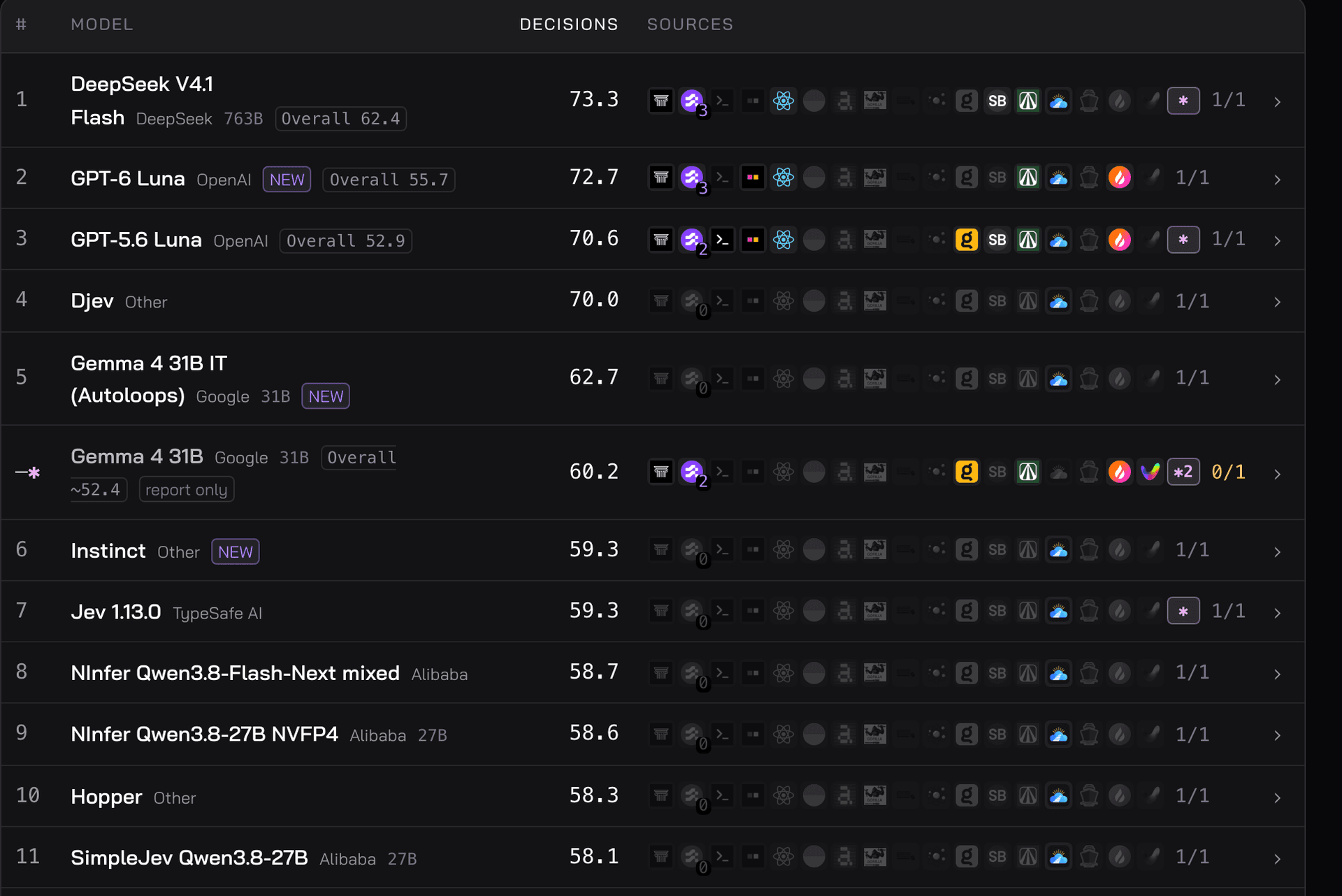
| # | model | Decisions | Overall index |
|---|---|---|---|
| 1 | DeepSeek V4.1 Flash | 73.3 | 62.4 |
| 2 | GPT-6 Luna | 72.7 | 55.7 |
| 3 | GPT-5.6 Luna | 70.6 | 52.9 |
| 4 | Djev | 70.0 | not ranked |
| 5 | Gemma 4 31B IT (Autoloops) | 62.7 | not ranked |
| 6 | Instinct | 59.3 | not ranked |
| 7 | Jev 1.13.0 | 59.3 | not ranked |
General-purpose models hold the top three. That is not what the board's own headline says, and the difference is worth understanding before you read either.
How to read it, and the sealed set
JevBench's headline score is four axes: Intelligence, Calibration, Speed and Cost. GPT-6 Luna has the highest Intelligence on the board at 97.4, and its two entries place 31st and 35th there, because by the board's measure it is slow and expensive. That is a fair thing to rank, and for a team paying per decision it may be the only thing that matters. It is not a capability question, so the Index reads the two axes that describe the model and leaves price and latency to the reader.
The board also keeps a control, which is rare and to its credit: 534 public decisions, 308 sealed ones, and a column for the gap.
| board rank | public (n=534) | sealed (n=308) | gap | |
|---|---|---|---|---|
| decider-4b v2 | 1 | 83.5% | 34.7% | +48.8 pp |
| Jev 1.13.0 | 2 | 86.6% | 36.7% | +49.9 pp |
| GPT-6 Luna | 35 | 99.6% | 95.5% | +4.1 pp |
Thirty-five entries score 80% or better on the public half. Thirty of them fall under 50% on the sealed one. Sort by the sealed column and the top four are general-purpose models, with the best specialist twenty-nine points behind the fourth.
A gap is not proof of anything by itself. A sealed set can be harder, and a small model tuned for one shape of task can be brittle rather than fitted. But the two figures agree only loosely, so if you are choosing one of these systems, the sealed number is the one to ask for. It is the board's own column, not our inference.
LargitData's write-up of the same question is indexed in this category too, marked ✱, at a tenth of a board's weight, as every report is. And one more piece of credit: Benchmark Heaven runs a router of its own, and excludes it from its own ranking.
Every figure above links back to the page it was read from. The same rows are available as JSON, over MCP, and as an RSS feed.