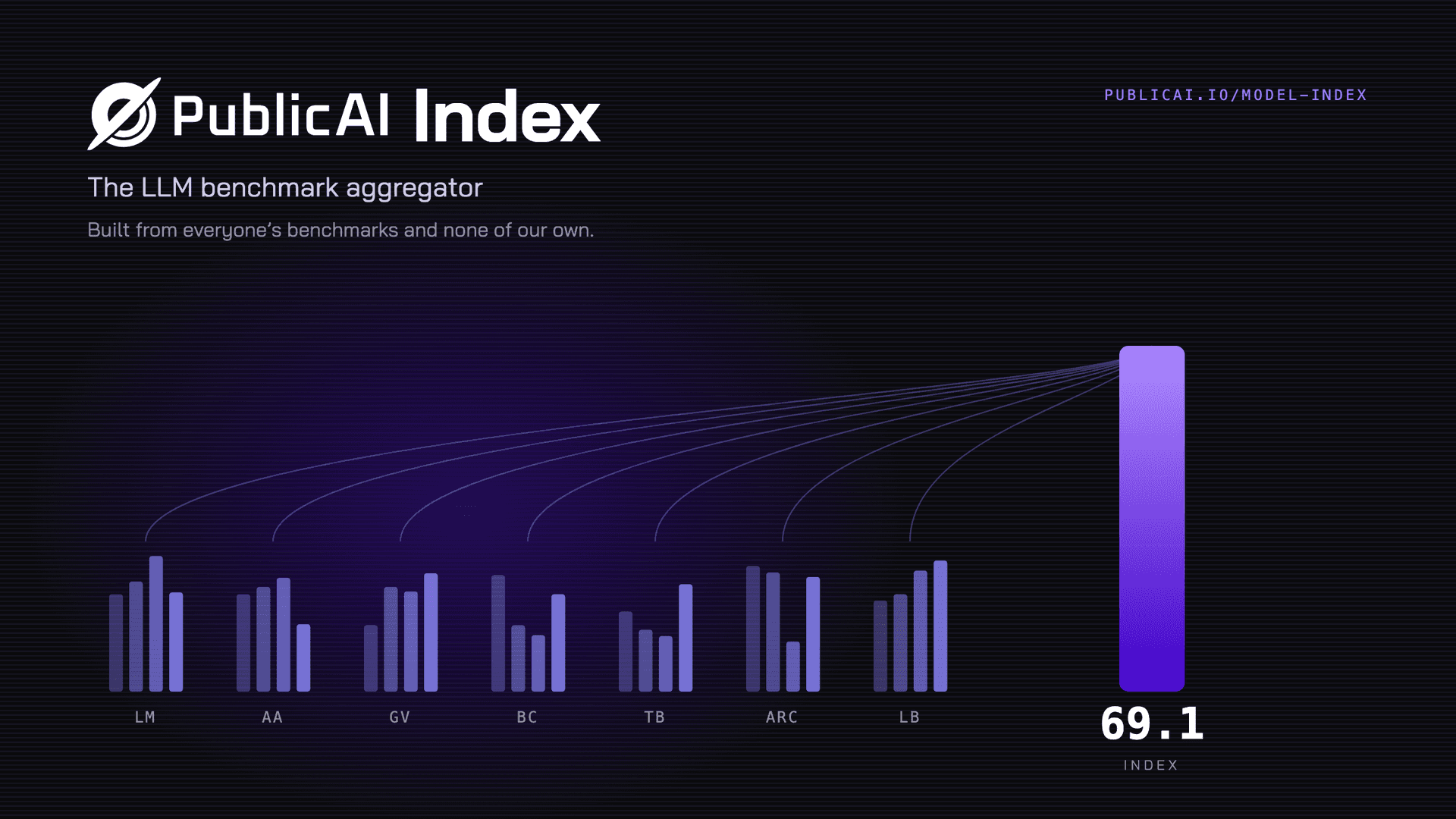
Model evaluation has fragmented into dozens of leaderboards, each with its own harness, and every launch ships with a table the vendor chose. A single benchmark is easy to target: a score that tops one board says little about the next.
Today we are launching the PublicAI Index, the LLM benchmark aggregator. It is the world’s most comprehensive and robust LLM index, and it is built from everyone’s benchmarks and none of our own.
We evaluate nothing
PublicAI runs no benchmarks. That is the point. Every figure on the Index is read from a public, first-party page. LMArena, Artificial Analysis, Terminal-Bench, ARC-AGI-2, LiveBench, LiveCodeBench, Aider, BFCL, OSWorld, MMMU, Kagi, SimpleBench, Vals.ai. Every figure links back to it. We normalize and weight; we do not score. No conflict of interest, nothing to tune to.
Six rules
- Standardize, discount uncertainty. Every figure is z-scored across the models its source lists and mapped to 0–100, so an Elo and a pass rate share one scale. Where a publisher prints an error bar, the figure counts for less.
- Shrink, never impute. A missing figure stays missing. Thin evidence is pulled toward 50, so one generous board cannot lift a barely-tested model.
- Weight by a published scheme. Each board’s share of the Overall index is fixed and printed beside the table, with its reason.
- Two publishers to rank. A model enters the Overall ranking once boards from two independent publishers have scored it. A domain ranks on its own board evidence.
- Reports ✱ stay out of the headline. Launch posts and blogs are indexed too, because they are how a brand-new model shows up before the boards catch it, but they are marked ✱, shape domain columns at a tenth of a board’s weight, and never enter the Overall index.
- Estimate the rest, and say so. A model with no Overall score is placed among models that have one and shown as ~55✱, and never ranked.
What is in it today
Fifteen recognised leaderboards from fourteen publishers, three reports ✱, 804 models, 51 domains under seven categories, from agentic coding, tool use and computer use to legal, finance, tax, medical and cybersecurity, with Vals.ai’s twenty-two expert-built evaluations giving the verticals real third-party measurement. Rank by category or domain; filter by model line, by size class (small ≤ 15B, medium, large, very large > 1T, undisclosed, all counted from the weights on Hugging Face and never estimated), by coverage. Every row opens into a card: scores by domain, how to call the model, and every source figure with the label the source printed. Every view has a link and a share card that show exactly what you filtered.
For agents, too
The Index is served over MCP and a JSON API, so an agent can ask “which model, and how do I call it?” and get the same answer a person reads on the page: every score with its sources, every model with the way to reach it.
{
  "mcpServers": {
    "publicai-index": { "url": "https://publicai.io/model-index/mcp" }
  }
}
Following it
The ranking moves when the boards move, which is not on a schedule you can guess. Three ways to hear about it without checking the page:
- Index Weekly, one email on Mondays: the week's biggest moves, models that entered the ranking, and sources added. Nothing else. Sign up on the Index.
- RSS, the same changes as a feed.
- A change feed for agents:
?since=2026-09-01on the JSON API, or thewhats_newtool over MCP, so a poller reads what moved instead of re-reading the whole ranking.
What is next
More recognised boards toward twenty: τ²-bench, SEAL, Epoch AI, HealthBench and others as they publish tables, each bringing its own domains; more reports as new models land; and the same rules throughout. The weighting is stated so it can be disagreed with. Tell us where we are wrong.